



Preservation Of Food

PRESERVATION OF FOOD
Preservation helps to avoid wastage of food. If food is preserved properly, can make seasonal food available throughout the year. If some delicio food items, are preserved properly, can be enjoyed throughout the year.
Fresh foodstuffs cannot stay longer in good condition, so they need to preserved. Bacteria and moisture spoil food. Thus for preserving food for long time it must be protected from bacteria and moisture. Following some methods of preserving food:
1. Low temperature:- Bacteria cannot survive or become inactive at very low temperatures. So, milk, eggs, meat and vegetables can be preserved by keeping them in a refrigerator.
In big towns and cities there are cold storages where vegetables and fruits in large number can remain fresh for a longer time.
2. Canning:- Foods like fruits, vegetables and fish are boiled, excess water is removed, sterilized and put into sterile germ free containers and tins. They are closed air-tight and sealed.
3. Pickling:- Pickling is the way of preserving some vegetables in excess oil. Salt is also a preservative. Lime, mango, prawn and many other vegetables are pickled with excess salt and oil in jars and bottles.
4. Salting:- Salt is a good preservative because micro-organisms cannot live in salt solution. Some vegetables and fruits can e salted and preserved for some time. Dry fish is salted and preserved.
5. Adding Sugar:- Sometimes fruits are preserved in sugar syrup. Sugar syrup removes water from bacteria and kills them. A good example of preservation of foodstuff by adding sugar is of jams. Fruit jams can be used throughout the year.
6.Chemical presevatives:-Preservatives stop microorganism growth in those foods that cannot be processed by such means as canning or freezing. Preservatives are used extensively in bread and other baked goods, pickled vegetables, fruit juices and cheese.
Common preservatives include benzoic acid, sorbic acid, and sulphur dioxide.
7.Drying:- Drying is a good method of preserving as it removes moisture  and prevents the growth of bacteria and other micro-organisms. Few vegetables like brinjals, lady’s fingers, cauliflowers, peas, beans. chilies, coriander, unripe mango fruits, dates, grapes and banana chips are dried well and kept air tight for weeks and months in dry bottles or plastic containers.
Potato chips, papad of different types are also preserved by drying method.
8.Boiling:- Boiling kills bacteria. So, oiling also helps in the preservation of liquid food like milk.
PRESERVATION OF DRIED GRAINS:-
Food-grains like rice, wheat, maize, bajra, jowar and pulses like gram, peas, beans are dried well in the sun to remove the moisture. They are then kept in dry containers. Once in a while they should be exposed to sunlight.
Teeth And Their Care

We eat food daily? We put it into our mouth. Our teeth break it into small bits. Then we chew the food well. When we chew the food, Saliva (a digestive juice) mixes up with it. Then we swallow it .Digestion of food starts in the mouth. The teeth help us to break the food into bits and chew them. Our teeth help us to pronounce the works correctly when we speak. The natural shape and appearance of our face are due to the teeth in our mouth .thus the teeth are useful to us.
Kind Of Teeth.
A new born baby does not have teeth. They appear in its mouth when the baby is six to twelve months old. As the baby grows, more teeth appear. By the time the baby is two years old, it will be having twenty teeth in its mouth. These are called milk teeth. Mild teeth are not permanent. As the child grows older and older these drop out and new ,big, strong teeth come ort in her places. These are permanent teeth. There are thirty-two teeth in the mouth of a grown up man, sixteen in the upper jaw and sixteen in the lower jaw.
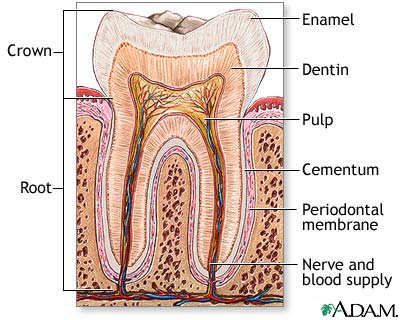
There are three kinds of teeth in a person’s mouth.Each kind has a special job:
1.Incisors (Cutting Teeth): Our front teeth act like scissors. These teeth are sharp and help us t cut the food into small pieces. There are 4 such cutting teeth in each jaw.
2. Canines (Tearing Teeth): On either side of the cutting teeth is a pointed tooth used for tearing and shredding food. These are four in numbers, two in each jaw.
3. Pre-molars and Molars (Grinding Teeth): The teeth at the back of the mouth help us to chew and grind the food well. They are strong. There are twenty grinding teeth, ten in each jaw.
TOOTH DECAY:- when we chew food small its of food get stuck in space between teeth. Bacteria act upon starch and sugar. An acid is produced on account of this action. Enamel—the white out covering of teeth—dissolves in the acid. tooth decay starts when enamel is dissolved.
The decayed parts slowly grows larger.
The inner parts get exposed to hot and cold substances and also to acids and sugar. Pus is also formed. The decayed tooth gives great pain.
When the tooth decays it gives off bad smell also because food particles in the decayed part begin to rot.
When you have decayed teeth, you are not able to chew the food properly. Indigestion and stomach troubles are caused. If there are decayed teeth, there will be harmful bacteria. These go along with the food into the body and cause diseases. When teeth are not cleaned properly, a substance called tartar is formed on the teeth. he teeth will have a bad appearance. The tartar will also push the gum away from the teeth.
Follow simple rules to avoid tooth decay,
1. Brush your teeth in the morning and before going t bed. Brushing
removes the food particles sticking in the teeth.
2. Use a good tooth paste or tooth powder.
3. Rub your teeth clean from all sides with your fingers when you rinse you
Mouth.
4. Avoid eating too much sweets and chocolates. Chocolates and sweets
harm the teeth.
5. Do not allow chocolates and sweets to stick to the teeth.
6. Do not eat when the food is too hot or too cold. Avoid cool drinks and ice
creams. These will affect the enamel and cause tooth decay.
7. Drink plenty of milk. This will help you to have strong teeth.
8. Visit your dentist regularly and get his advice. This will help you to be a
healthy person.
9. Wash the mouth well after eating anything. so no food particles stay in the
mouth sticking to the teeth in spaces between them.
to strengthen your teeth and gums. Hard food will give sufficient exercise
to the teeth and will also help them to be strong.
1. Foul smell in the mouth.
2. Teeth begin to decay.
3. Tooth decay causes toothache and diseases.

4. Bad teeth bring indigestion and stomach problems.
1. Eat foods that have vitamins and minerals.
2. Do not eat sweets and sticky foods between meals.
3. Brush your teeth after every meal to remove plaque.
4. Use trusted dental aids.
5. Visit your dentist every six months.